


 PLATFORM UPDATE:

Core-linked dimer acceptors with a flexible linker for high-efficiency and robust organic solar cells
 *ac
Guangliu
Ran,
d
Jianqi
Zhang,
e
Hao
Lu,
*c
Wenkai
Zhang,
d
Zhishan
Bo
*f
and
Yahui
Liu
*a
*ac
Guangliu
Ran,
d
Jianqi
Zhang,
e
Hao
Lu,
*c
Wenkai
Zhang,
d
Zhishan
Bo
*f
and
Yahui
Liu
*a
Abstract
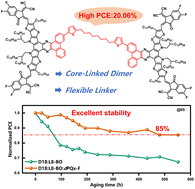
Oligomerized small-molecule acceptors (OSMAs) have been applied to tackle the stability challenge of organic solar cells (OSCs) owing to their elevated glass-transition temperatures, which can suppress molecular diffusion and contribute to the stabilization of device morphology. In this work, we designed and synthesized a core-connected OSMA, dPQx-F, by integrating a flexible alkyl-chain linker, which can regulate the solubility and crystallization properties. The incorporation of dPQx-F into the D18 : L8-BO system not only facilitated the formation of a fibrous morphology but also restricted the self-aggregation of the acceptor phase. As a result, the D18 : L8-BO : dPQx-F-based device realized a remarkable power conversion efficiency of 20.06% with an outstanding thermal stability. After thermal aging at 65 °C for 550 h, it still maintained 85% of its original efficiency. This work presents an efficient approach to resolve the trade-off among molecular structure, device performance and stability.
- This article is part of the themed collection: Journal of Materials Chemistry A HOT Papers
 Please wait while we load your content...


