


 PLATFORM UPDATE:


Solid-state synthesis of efficient supported iridium catalysts for the acidic oxygen evolution reaction

Abstract
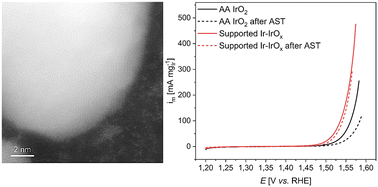
Proton-exchange membrane (PEM) water electrolysis is a key technology for green hydrogen production, offering distinct advantages such as compatibility with intermittent renewable energy sources. However, its large-scale deployment remains hindered by the lack of abundant and cost-effective catalysts for the acidic oxygen evolution reaction (OER). At present, Ir-based materials are the only viable type of catalyst with sufficient activity and stability under industrial operating conditions. While significant recent advances in Ir recycling have helped reduce concerns about availability and cost, achieving scalable and rapid synthesis of high-performance Ir catalysts remains a major challenge. Here, we present a solid-state synthesis method for producing highly active and durable supported Ir catalysts for acidic OER. Under OER conditions, the as-synthesized supported Ir nanoparticles transform into Ir–IrOx core–shell structures with partially or fully oxidized surfaces that exhibit excellent performance as demonstrated by reproducible electrochemical tests, delivering three-fold higher mass-specific activity (174 mA mgIr−1 at 1.55 V vs. RHE), more than ninefold higher surface-specific activity (1295 mA C−1 at 1.55 V vs. RHE), and enhanced stability (retaining 83% of the mass-specific activity and 92% of the surface-specific activity after stress tests) compared with a benchmark IrO2 catalyst. The structural robustness of the Ir–IrOx configuration during acidic OER was validated through a range of ex situ and in situ characterization techniques. This synthesis approach and the resulting catalyst architecture provide valuable guidance for the rational design of advanced materials to enable sustainable green hydrogen production.
 Please wait while we load your content...


