


 PLATFORM UPDATE:


Integrating single-site Co catalytic centers into a Zr-MOF without sacrificing light-harvesting units for enhanced photocatalysis
 *b
and
Jiandong
Pang
*a
*b
and
Jiandong
Pang
*a
Abstract
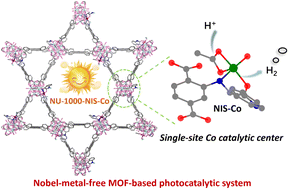
Metal–organic frameworks (MOFs) are promising photocatalysts for solar fuel production, but some conventional methods for introducing catalytic sites often sacrifice the visible-light-harvesting components. Herein, a Zr-MOF with single-site Co centers (NU-1000-NIS-Co) was constructed while preserving the intrinsic photosensitive units through a linker installation strategy. NH2-BDC linkers were pre-anchored as secondary building blocks within a mesoporous Zr-MOF (NU-1000), followed by a Schiff base condensation reaction and Co coordination. The obtained NU-1000-NIS-Co demonstrated a superior photocatalytic H2 evolution rate (190 µmol g−1 h−1), which is 1.53 times higher than that of NU-1000@Pt. Photoelectrochemical experiments and DFT calculations confirmed the efficient photogenerated electron transfer from TBAPy4− visible-light absorbers to Co catalytic centers. This work presents a viable approach for developing noble-metal-free MOF photocatalysts with spatially separated functional components.
- This article is part of the themed collection: New Developments in Photofunctional Materials and Transformations
 Please wait while we load your content...


