


 PLATFORM UPDATE:

Dynamic confinement of Cu3 clusters in T-C3N2 pores: an adaptive interface for selective CO electroreduction to C3 products

Abstract
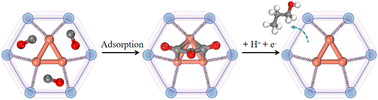
The rational design of catalysts with dynamically adaptive active sites is crucial for steering multi-carbon product formation in CO electroreduction. Herein, we propose a confined and flexible triatomic Cu3 cluster anchored within the pores of a two-dimensional carbon nitride T-C3N2 monolayer (Cu3@T-C3N2) as an efficient electrocatalyst. The suitable pore size—5.534 Å—of T-C3N2 not only stabilizes the Cu3 cluster but also allows its dynamic structural adaptation during the reaction. This unique configuration facilitates the optimal adsorption and aggregation of *CO intermediates and can promote the trimerization of *CO through a synergistic coupling pathway. Consequently, the catalyst achieves remarkably low limiting potentials of −0.18 V for n-propanol and −0.24 V for propene, significantly outperforming conventional static Cu-based catalysts. Furthermore, the confined and adaptive structure effectively suppresses competing hydrogen evolution and C1/C2 pathways, resulting in superior C3 selectivity with a propanol-to-methane ratio up to 2.59 × 10³ : 1. This study establishes Cu3@T-C3N2 as a highly efficient triatomic CORR catalyst and provides a general design principle for confined, adaptive electrocatalysts.
 Please wait while we load your content...


