


 PLATFORM UPDATE:


Time-phase-controlled exsolution of FeCoNi ternary alloy nanoparticles on perovskite anode catalyst for enhanced dual-functional catalysis and protection in ammonia-fueled protonic ceramic fuel cells

Abstract
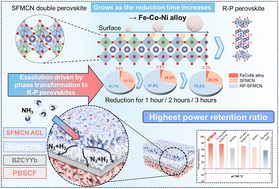
Ammonia is a promising carbon-neutral fuel, yet its application in protonic ceramic fuel cells (PCFCs) is hindered by the poor durability and catalytic efficiency of conventional Ni-based anodes. In this study, we present a novel time-phase-controlled exsolution strategy to fabricate a Sr2Fe1.5Mo0.35Co0.1Ni0.05O6−δ (SFMCN) perovskite anode catalytic layer (ACL). This approach enables the in situ formation of uniformly dispersed FeCoNi ternary alloy nanoparticles, sized between 20 to 40 nm, achieving an exceptionally high triple phase boundary areal density of 46.81 µm µm−2 through reduction-induced phase transformation. The ACL undergoes sequential phase evolution with prolonged reduction, where the Ruddlesden–Popper (R–P) perovskite phase content increases from 61.7 wt% to 70.8 wt%, accompanied by an increase in alloy nanoparticle content from 2.6 wt% to 3.2 wt%. The optimized PCFC exhibits complete (100%) ammonia decomposition at 700 °C while effectively protecting the Ni-based anode from corrosion. Moreover, it demonstrates superior power retention under ammonia compared to hydrogen, maintaining stable operation for over 100 hours at 650 °C. Density functional theory calculations reveal that the FeCoNi alloy features a tailored electronic structure with enhanced catalytic activity for ammonia decomposition. Additionally, the R–P perovskite phase within the ACL is identified as a potential proton conductor, facilitating effective coupling between the nanoparticles and the Ni-based anode. This study addresses critical challenges in ammonia-decomposing electrocatalysts and advances the development of efficient and durable direct-ammonia PCFCs.
 Please wait while we load your content...


