


 PLATFORM UPDATE:


Nanohybrids of Ti3C2Tx MXene with Ni-based structures: enabling high-performance electrocatalysts for water splitting
 a
Sadhasivam
Thangarasu,
*a
Gowthami
Palanisamy,
ad
Mrunal
Bhosale,
a
Mahaveer D.
Kurkuri,
b
Ranjith Krishna
Pai
c
and
Tae Hwan
Oh
*a
a
Sadhasivam
Thangarasu,
*a
Gowthami
Palanisamy,
ad
Mrunal
Bhosale,
a
Mahaveer D.
Kurkuri,
b
Ranjith Krishna
Pai
c
and
Tae Hwan
Oh
*a
Abstract
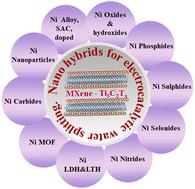
In hydrogen production technologies, the greener way of electroca'talytic water splitting (EWS) techniques has gained considerable attention in the recent past because of the utilization of renewable energy as a source to produce hydrogen without any harmful emissions. Hydrogen production via EWS techniques majorly depends on the activity of the electrocatalyst. Thus, key attempts are focused on searching novel electrocatalysts with high performance and stability to replace the traditional high-cost platinum group metal-based electrocatalysts (such as Pt, RuO2, and IrO2). The MXene (Mn+1XnTx) nanostructure of Ti3C2Tx has been significantly considered as an effective and high-performance material for EWS applications because of its intrinsic properties, such as large active surface area, hydrophilicity, efficient metallic conductivity, low ion diffusion barriers, higher electron transport, and effective formation of composites via surface functional groups. However, the utilization of Ti3C2Tx alone as an electrocatalyst has certain drawbacks, such as the possibility of higher oxidation rates, restacking/aggregation, and structure breakdown under increased surface energy, which affects the benefits for the HER and OER. Thus, the formation of nanohybrid structures of Ti3C2Tx with different phases of nickel (Ni) can enhance overall water splitting through multiple mechanisms, resulting in a strong interface effect, improved electron and ion transport, increased electrical conductivity, surface energy alterations, increase in the active surface area, and reduced activation barrier. In this review, we comprehensively explained the impact of Ti3C2Tx and its performance modification through various types of Ni-based compounds for water-splitting applications. This review is structured into nine main sections focusing on Ti3C2Tx with different kinds of Ni-based compounds, namely, (i) Ni single-atom, Ni-doped, and Ni nanoparticles; (ii) Ni-based alloys/composites; (iii) NiO, Ni(OH)2 and Ni-containing bimetallic/trimetallic/high-entropy oxides; (iv) Ni-phosphides; (v) Ni-sulphides; (vi) Ni-selenides; (vii) Ni-based tellurides, nitrides, and carbides; (viii) Ni-containing LDH and LTH; and (ix) Ni-containing MOFs. In each section, the formation of the composite structure and the role of Ti3C2Tx with Ni-based composites towards efficient HER and OER have been explained in detail. This review provides a comprehensive overview of the recent developments, research gaps, and future perspectives of the nanohybrids of Ni-based compounds with Ti3C2Tx.
- This article is part of the themed collection: Journal of Materials Chemistry A Recent Review Articles
 Please wait while we load your content...


