


 PLATFORM UPDATE:


Bubble evolution dynamics and interfacial management strategies for high-flux water electrolysis: a review
 *a
*a
Abstract
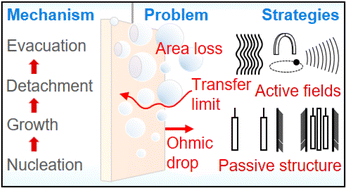
Water electrolyzers are crucial for large-scale green hydrogen production and serve as a foundational technology for future sustainable energy systems. However, the formation of gas bubbles at the electrode surface during electrolysis reduces the active electrode area, increases the electrolyte's ohmic resistance, and induces undesirable concentration gradients, all of which significantly hinder energy and mass transfer efficiency. Despite its importance, the issue of bubble formation has not received adequate attention, and research on this topic remains fragmented. This review aims to consolidate recent advancements in the study of bubble effects, focusing on the fundamental modes of bubble evolution and their specific impact on electrode reactions. It also systematically classifies strategies to enhance bubble removal and highlights the key challenges and opportunities for future research. By providing this comprehensive overview, this review lays the groundwork for the design of high-performance electrolyzers and other energy conversion/storage systems that involve gas-phase reactions.
- This article is part of the themed collection: Journal of Materials Chemistry A Recent Review Articles
 Please wait while we load your content...


