


 PLATFORM UPDATE:


Ordered VO2 nanoflowers with amorphous hybrid interfaces induced by iodide ion doping for superior zinc-ion storage
 *a
*a
Abstract
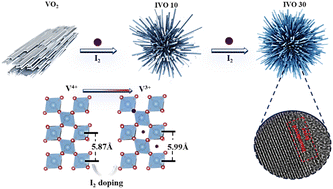
With its special one-dimensional tunnel structure, VO2 stands out as a highly promising cathode material for aqueous zinc-ion batteries (AZIBs). However, its intrinsically low electronic conductivity and pronounced structural degradation hinder its practical application. In this work, controllable doping of VO2 with I− was successfully achieved via a one-step hydrothermal method. It was found that I− induced the evolution of VO2 from disordered clusters to highly ordered nanoflower-like spheres. Meanwhile, lattice incorporation of I− led to an expansion of the tunnel spacing and induced the enrichment of oxygen vacancies. The resulting amorphous hybrid structure accommodated the local strain associated with repeated Zn2+ insertion and extraction. In addition, I− doping facilitated the valence transition from V4+ to V3+, optimizing the intrinsic electronic structure and charge-transfer kinetics. The multiscale routes including morphology, crystal structure, and electronic states synergistically enhanced the electrochemical performance of the VO2 cathode. The optimized IVO-30 electrode delivered a high specific capacity of 543.6 mAh g−1 at 0.5 A g−1, retained 87.3% of its capacity even at a high rate of 10 A g−1 and exhibited near-100% coulombic efficiency along with excellent structural stability. This work provides new insights for design of high-performance cathode materials for AZIBs.
 Please wait while we load your content...


