


Hexaazaphenalene-based pore-space-partitioned metal–organic frameworks for enhanced CO2 capture and photocatalytic fixation

Abstract
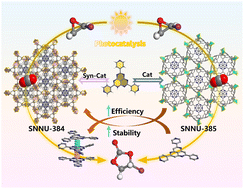
Hexaazaphenalene (HAP), a well-known large-ring conjugated system that endows its derivatives with abundant Lewis basic N-sites and excellent photoresponsive property, provides an ideal molecular design platform for CO2 capture and conversion. However, the strong π–π conjugation between the HAP rings usually blocks the crystallization of porous crystalline materials. Herein, 2,5,8-tri(4-pyridyl)-1,3,4,6,7,9-hexaazaphenalene (TPHAP) is selected as an auxiliary ligand to combine with different tritopic organic linkers to fabricate two new pore-space-partitioned metal–organic frameworks (MOFs, SNNU-384 and SNNU-385). The TPHAP ligand acts as a pore partitioner through the insertion of pyridyl groups into the 1D hexagonal channels of parent frameworks to generate suitable pore spaces and helps in stabilizing the MOF architectures. Notably, SNNU-384 achieves a synergistic framework partition through three partitioner units, featuring higher HAP density, larger pore surface area and more Lewis basic N active sites than SNNU-385. Accordingly, SNNU-384 exhibits excellent room-temperature CO2 adsorption capacity of 56.0 and 308.6 cm3 g−1 under 1 bar and 30 bar, respectively, which are nearly three times that exhibited by SNNU-385. Furthermore, under visible-light irradiation, SNNU-384 can efficiently convert CO2 molecules and various epoxides into cyclic carbonates (CCs) with a top-level turnover frequency (TOF) of 104.18 h−1, maintaining nearly unchanged catalytic activity after six cycles. GCMC simulations verify dense CO2 distribution in the partitioned MOF cages via multiple intermolecular interactions, including π–π stacking, hydrogen bonding, and C–N dipole–dipole interactions. At the same time, HAP-directed MOF frameworks with dual band gaps and additional absorption response at 700 nm (confirmed by UV-vis spectroscopy) enhance light harvesting. Electronic structure and photo-response analyses as well as in situ FT-IR spectra further confirm the efficient photocatalytic fixation of CO2 into carbonate intermediates and cyclic carbonate products using hexaazaphenalene-based pore-space-partitioned MOFs.
 Please wait while we load your content...


