


 PLATFORM UPDATE:


Magnetic enhancements of defect-mediated spin polarized photocatalytic CO2 reduction of Sn2P2S6
 †ab
Cheng-Yu
Yu,
†c
Cheng-Chieh
Lin,
ab
Yung-Hung
Huang,
ab
Michitoshi
Hayashi,
d
Ching-Hwa
Ho,
f
Heng-Liang
Wu,
*ad
Chia-Chun
Chen
*e
and
Chun-Wei
Chen
*acd
†ab
Cheng-Yu
Yu,
†c
Cheng-Chieh
Lin,
ab
Yung-Hung
Huang,
ab
Michitoshi
Hayashi,
d
Ching-Hwa
Ho,
f
Heng-Liang
Wu,
*ad
Chia-Chun
Chen
*e
and
Chun-Wei
Chen
*acd
Abstract
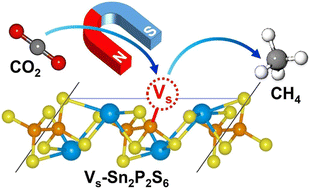
Manipulation of electron spin polarization has emerged as a promising strategy for regulating charge-carrier dynamics and enhancing photocatalytic activity. Vacancy (defect) engineering provides an effective approach to increase the population of unpaired spin electrons, thereby promoting photocatalytic CO2 reduction. In this work, we demonstrate enhanced CO2 reduction efficiency in Sn2P2S6 by harnessing spin-polarized electrons through the synergistic introduction of sulfur vacancies and the application of an external magnetic field. In situ diffuse reflectance infrared Fourier transform spectroscopy (DRIFTS) measurements under an external magnetic field were employed to monitor reaction intermediate formation during CO2 photoreduction on sulfur-vacancy-engineered Sn2P2S6 (Vs-Sn2P2S6). The results provide direct spectroscopic evidence that the magnetic field significantly promotes the formation of key reaction intermediates, including COOH*, CHO*, and CH3O*, which are closely associated with CH4 evolution. First-principles calculations further confirm that these intermediates can be stably accommodated on sulfur-deficient Sn2P2S6 surfaces, providing theoretical support for the reaction pathways revealed by the in situ DRIFTS measurements. Collectively, these findings demonstrate that external magnetic fields facilitate intermediate formation and enhance CH4 yield, highlighting the synergistic potential of integrating defect engineering with magnetic enhancement for the rational design of advanced photocatalysts.
- This article is part of the themed collection: Journal of Materials Chemistry A HOT Papers
 Please wait while we load your content...


