


 PLATFORM UPDATE:

Ion-exchange assisted charge storage via strategic intercalation of ZnCo2O4/V2O5 heterostructures for high-energy hybrid supercapacitors

Abstract
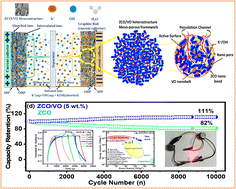
Designing advanced transition-metal heterostructures with high energy density, high power density, and excellent stability remains crucial for next-generation hybrid supercapacitors. Herein, oxygen-vacancy-enriched ZnCo2O4/V2O5 (ZCO/VO) heterostructures with ion-exchange-assisted V–Co charge storage were fabricated through a simple hydrothermal method. The rational integration of V2O5 (VO) into ZnCo2O4 (ZCO) nanorods enhances crystallinity, generates oxygen vacancies, and enriches surface intercalation sites, leading to enhanced electronic conductivity and redox activity. Structural and surface analyses confirm the coexistence of multiple valence states (Co2+/Co3+) and (V4+/V5+) and a highly crystalline spinel-orthorhombic heterointerface, promoting rapid ion diffusion and efficient charge transfer. The optimized ZCO/VO (5 wt%) electrode delivers a high specific capacitance of 2632 F g−1 at 1 A g−1 in a three-electrode system, retaining 111% of its initial capacitance after 10 000 cycles, attributed to progressive electrolyte penetration and electrochemical activation. A symmetric device assembled with ZCO/VO achieves an energy density of 39 W h kg−1 at a power density of 750 W kg−1, while the asymmetric ZCO/VO//AC cell attains an outstanding energy density of 102 W h kg−1 at 4050 W kg−1 with 102% stability over 10 000 cycles, successfully powering a red LED for 27 minutes. The superior electrochemical performance stems from the synergistic effect of V–Co ion exchange, a defect-enriched architecture, and enhanced interfacial redox kinetics, underscoring the potential of the ZCO/VO heterostructures as robust electrode materials for high-energy, long-life supercapacitors.
 Please wait while we load your content...


