


 PLATFORM UPDATE:


Unveiling the role of a trinuclear copper(ii) cluster in bifunctional OER and HER electrocatalysis: insights from experiments and theory
 a
Trishna
Ghosh,
a
Aditi
De,
bc
Julia
Klak,
d
Yutaka
Hitomi,
e
Subrata
Kundu
*bc
and
Manindranath
Bera
*a
a
Trishna
Ghosh,
a
Aditi
De,
bc
Julia
Klak,
d
Yutaka
Hitomi,
e
Subrata
Kundu
*bc
and
Manindranath
Bera
*a
Abstract
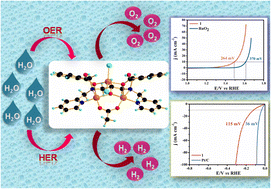
Electrocatalytic water splitting offers a safe, trouble-free and high-purity alternative for hydrogen production, garnering considerable attention in recent times. However, the poor catalytic activity of currently used state-of-the-art catalysts due to sluggish reaction kinetics, combined with their reliance on costly and rare elements, prevents the widespread application of water-splitting technology. Thus, development of effective, inexpensive and durable electrocatalysts is of utmost importance and high priority for renewable energy systems. Herein, we demonstrate a combined approach of experimental and theoretical investigations of electrochemical water splitting using a novel trinuclear copper(II) cluster [Cu3(L)(OAc)(Cl)2]·3H2O (H3L = N,N′-bis[2-carboxybenzomethyl]-N,N′-bis[2-pyridylmethyl]-1,3-diaminopropan-2-ol; OAc = acetate) as an efficient bifunctional electrocatalyst for the hydrogen evolution reaction (HER) and oxygen evolution reaction (OER). Construction of this cluster is achieved by the self-assembly approach upon incorporation of one µ:η1:η1-acetate and two µ:η2-benzoate functionalities through the [CuII(µ-O2CCH3)CuII] and [CuII(µ-O2CC6H5)CuII] units, respectively. The overall electronic environments of the Cu centers in this cluster are tuned and modulated by a synergistic combination of coordinated alkoxide, acetate, benzoate and chloride for expediting water-splitting reactions. Thorough electrochemical studies confirm enhanced bifunctional activity towards both the OER and HER with low overpotentials (η) at 10 mA cm−2 (264 mV for the OER and 115 mV for the HER) and small Tafel slopes (65.01 mV dec−1 for the OER and 42.45 mV dec−1 for the HER). Detailed density functional theory (DFT) calculations indicate that the occurrence of adjacent active sites greatly supports facile formation of molecular O–O and H–H bonds, and their mechanistic aspects have been elucidated. Our experimental and theoretical findings clearly suggest that Cu-based efficient bifunctional water-splitting electrocatalysts can be developed by designing molecular systems with redox-flexibility and by locating water-activation sites close to each other, which lower the energy required to form molecular O–O and H–H bonds, making these processes more competent.
- This article is part of the themed collection: Journal of Materials Chemistry A HOT Papers
 Please wait while we load your content...


