


 PLATFORM UPDATE:

A graphite paper anode with low lattice mismatch enables corrosion inhibited zinc batteries

Abstract
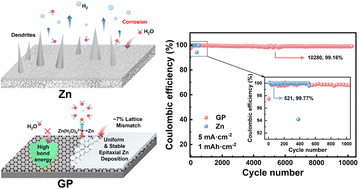
The severe corrosion of zinc metal anodes remains a major obstacle to the practical application of aqueous zinc-ion batteries (AZIBs). In contrast to conventional complex surface modification strategies, for the first time, this work systematically elucidates the corrosion resistance mechanism and lattice matching advantage of graphite paper (GP) in aqueous zinc-ion batteries. Owing to GP's inherent excellent chemical stability, low lattice mismatch (δ ≈ 7%) with the Zn(002) plane, and enhanced hydrophilicity after plasma treatment, the GP anode enables uniform zinc deposition/dissolution, while significantly suppressing corrosion, dendrite growth, and side reactions in acidic ZnCl2 electrolyte. Half-cell tests demonstrate an ultra-long cycle life exceeding 1500 hours at 5 mA cm−2 and 5 mAh cm−2, with an average coulombic efficiency (CE) as high as 99.2%. The assembled Zn–iodine battery realizes stable cycling for over 10 000 cycles at 5 mA cm−2. Notably, as an inexpensive and readily available commercial material, GP requires no complex synthesis or modification steps, significantly reducing production costs and demonstrating great potential for large-scale applications. A large-sized pouch battery assembled based on this strategy operated stably for over 1100 cycles and effectively powered commercial electronic devices. This work provides a novel, low-cost, high-throughput, and industrialization-friendly pathway for developing long-lifespan aqueous zinc batteries.
- This article is part of the themed collection: Journal of Materials Chemistry A HOT Papers
 Please wait while we load your content...


