


 PLATFORM UPDATE:


Polymer dots enabling ultrahigh capacitive energy storage in cellulose-based all-organic nanocomposites
 *b
*b
Abstract
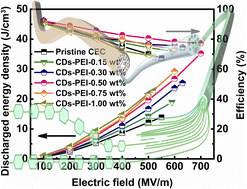
Dielectric capacitors represent a promising alternative to conventional electrochemical counterparts for applications in high-voltage networks, integrated circuits, and portable flexible electronics. Currently, most practical dielectric polymers are derived from petroleum-based sources, whereas environmentally sustainable biomass dielectric materials remain largely underexplored. We report a class of cyanoethyl cellulose (CEC)-based nanocomposites enhanced with polyethyleneimine-based polymer dots (PEPDs), which simultaneously elevate both the dielectric constant (εr) and breakdown strength (Eb). The wide-band-gap PEPDs with abundant amino groups form hydrogen bonds with the CEC backbone, ensuring uniform dispersion and creating continuous polar interfacial regions that substantially improve εr. In parallel, the high electron affinity of the polymer matrix, together with deep-level traps introduced by the wide-band-gap PEPDs, effectively suppresses charge migration and reduces conductive loss, leading to a notable enhancement in Eb. As a result, the optimized composite achieves a remarkable discharged energy density (Ud) of 35.2 J cm−3 at 700 MV m−1, outperforming current dielectric biomass materials. This work establishes a promising pathway for the development of cellulose-based nanocomposites toward next-generation high-energy-density dielectric capacitors.
- This article is part of the themed collection: Journal of Materials Chemistry A HOT Papers
 Please wait while we load your content...


