


Emerging strategies for designing MoSe2-based electrocatalysts for renewable hydrogen technologies
 †a
Aniruddha
Kundu
*a
†a
Aniruddha
Kundu
*a
Abstract
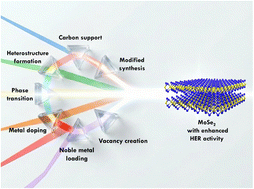
Molybdenum diselenide (MoSe2) has emerged as a promising non-noble metal electrocatalyst for the hydrogen evolution reaction (HER) owing to its unique physicochemical properties, such as near-optimal hydrogen adsorption energy, relatively high intrinsic electrical conductivity, tunable phase structure, and adaptable morphological design. Nonetheless, the practical HER performance of pristine MoSe2 is intrinsically constrained by catalytically inert basal planes, the predominance of the semiconducting 2H phase, low active-site density, sluggish charge-transfer kinetics, and structural instability during extended electrochemical operation, resulting in increased overpotentials and minimal activity relative to noble-metal catalysts. This review systematically discusses the recent advancements focused on overcoming these limitations through strategic materials engineering approaches. The principal methodologies examined include phase transition engineering (2H to 1T), the generation of defects and vacancies, transition-metal doping, heterostructure fabrication, noble-metal loading, and carbon support. This study addresses the correlations among synthesis techniques, structural modification, and electrical control in connection to electrocatalytic performance measures, therefore offering a broad understanding of the structure–activity linkages in MoSe2-based electrocatalysts. Finally, the remaining challenges associated with MoSe2-based electrocatalysts, including phase instability, precise defect control, and long-term durability under industrially relevant current densities, are critically discussed, and potential future research directions are outlined. This article provides comprehensive insights into the synthesis of MoSe2-based electrocatalysts with diverse morphologies and configurations, along with a concise mechanistic understanding of the HER catalysed by MoSe2-based composites. These findings may aid readers in increasing and widening the potential applications of transition metal dichalcogenide-based materials in renewable energy technology.
- This article is part of the themed collection: Journal of Materials Chemistry A Recent Review Articles
 Please wait while we load your content...


