


Sustainable magnesium phosphate cement from industrial by-products: long-term chloride resistance and non-alkaline corrosion protection mechanism
 a
a
Abstract
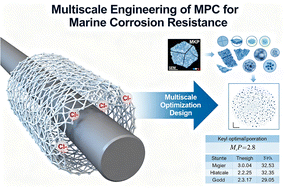
To address the dual challenges of solid waste valorization and the need for durable rapid-repair materials in chloride environments, this study develops a sustainable magnesium phosphate cement (sust-MPC) utilizing low-grade MgO by-products and circulating fluidized bed (CFB) fly ash. The long-term corrosion protection performance for steel reinforcement was systematically evaluated through a two-year natural immersion program in 3.5% NaCl solution, simulating marine bridge conditions. This is among the first studies to evaluate sust-MPC under two-year natural marine immersion. Multi-scale characterization techniques, including electrochemical monitoring, chloride profiling, XRD, TGA, SEM, and low-field NMR, were employed. Results demonstrate that an optimized mixture (M/P = 2.8, W/MPFS = 0.18, 0.1% borax, 22% FA + SF) achieves exceptional chloride resistance, exhibiting a remarkably low diffusion coefficient of 8.61 × 10⁻¹³ m2 s−1 and a minimal steel mass loss of only 2.29%. The superior protection mechanism is attributed to a synergistic microstructure where well-crystalline MgKPO4·6H2O (MKP) formation interweaves with a refined pore network (e.g., increased gel pore proportion to 22.75%), creating an effective physical barrier against chloride ingress—a paradigm distinct from the alkaline passivation of Ordinary Portland Cement. This work provides not only a scientifically grounded understanding of the non-alkaline protection mechanism but also a practical, eco-friendly formulation strategy for high-performance repair materials, contributing to the sustainable maintenance of marine infrastructure.
 Please wait while we load your content...


