


 PLATFORM UPDATE:


Ferrocenyl-dithiolane integrated Cu(i) coordination polymers: framework engineering for synergistic redox activity towards supercapattery applications

Abstract
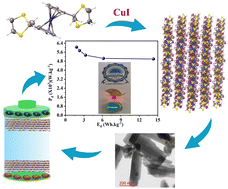
This work presents the rational design of ferrocene-integrated Cu(I) coordination polymers (CPs) that harness the synergistic redox activity of Fe(II) and Cu(I) centers for high-performance energy storage. Two new CPs, Fc-Cu1 and Fc-Cu2, were obtained by self-assembly of CuI with (2-methyl-1,3-dithiolan-2-yl)ferrocene and 1,1′-bis(2-methyl-1,3-dithiolan-2-yl)ferrocene, respectively. Both CPs consist of a similar [{Cu2(µ4-I)(µ2-I)}]n array where ferrocene ligands coordinate via sulfur atoms, leading to a one-dimensional polymeric structure for Fc-Cu1 and a layered 2D architecture for Fc-Cu2. The 2D architecture of Fc-Cu2 improves electrical conductivity, charge transport, and ion diffusion compared to its 1D counterpart, resulting in a higher diffusion-controlled charge storage capacity of 450 C g−1 (areal capacity: 855 mC cm−2) at 1 A g−1. A symmetric supercapattery device assembled using Fc-Cu2 electrodes delivers a maximum energy and power density of 14.5 Wh kg−1 and 6 kW kg−1, respectively, and retains 85% of its initial capacity over 10 000 cycles, demonstrating excellent cycling stability. This study underscores the significance of combining multiple redox-active centers with controlled framework dimensionality in the development of next-generation CP/MOF-based energy storage systems.
 Please wait while we load your content...


