


 PLATFORM UPDATE:


A tetraphenyl-p-phenylenediamine- and benzodithiophene-4,8-dione-based conjugated microporous polymer as a robust cathode for durable aqueous Zn batteries

Abstract
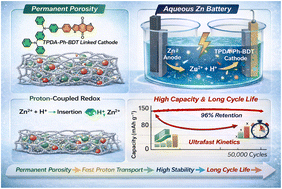
Redox-active conjugated microporous polymers (CMPs) are promising sustainable electrode materials; however, achieving high capacity, rapid charge–discharge kinetics, and long-term cycling stability simultaneously in aqueous Zn batteries remains a major challenge. Here, we report a tetraphenyl-p-phenylenediamine- and benzodithiophene-4,8-dione-linked CMP (TPDA-Ph-BDT) featuring a rigid π-conjugated skeleton, permanent porosity, and a high density of carbonyl/amine redox sites. Distinct from most reported organic/polymer cathodes, this design integrates amine and carbonyl dual-redox centers directly into an insoluble porous skeleton, providing high redox-site density and rapid ion/proton transport pathways. As a result, TPDA-Ph-BDT CMP delivers a high reversible capacity of 154 mA h g−1 at 0.5 A g−1 and outstanding high-rate stability, retaining 85 mA h g−1 over 50 000 cycles at 20 A g−1 with 96% capacity retention when used as a cathode in a mild aqueous ZnSO4 electrolyte. Mechanistic analyses (ex situ FTIR/XPS/solid-state NMR and in situ pH evolution) reveal that charge storage is dominated by reversible proton-coupled redox at the C![[double bond, length as m-dash]](https://www.rsc.org/images/entities/char_e001.gif) O and amine N centers, enabled by rapid proton transport through the porous conjugated network. Kinetic analyses reveal a low apparent activation energy (315 meV) and predominantly capacitive charge storage, both of which explain the outstanding rate performance. This work establishes CMP structural engineering as a powerful route to high-performance, metal-free cathodes and provides clear design principles for next-generation aqueous zinc-based energy storage.
O and amine N centers, enabled by rapid proton transport through the porous conjugated network. Kinetic analyses reveal a low apparent activation energy (315 meV) and predominantly capacitive charge storage, both of which explain the outstanding rate performance. This work establishes CMP structural engineering as a powerful route to high-performance, metal-free cathodes and provides clear design principles for next-generation aqueous zinc-based energy storage.
- This article is part of the themed collection: Advanced aqueous batteries
 Please wait while we load your content...


