


Multifunctional sulfamic acid additive for synergistic electrolyte regulation toward long-cycling aqueous zinc-ion batteries
 *ab
*ab
Abstract
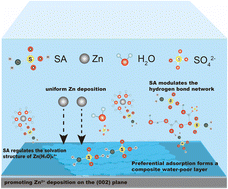
In this study, sulfamic acid (SA) was proposed and validated as a multifunctional electrolyte additive to enhance the stability and reversibility of aqueous zinc-ion batteries (AZIBs), and the concentration ratio of the additive was obtained via a scientific single-factor sequential search method. Endowed with a unique molecular structure, SA exerts a multifunctional regulation mechanism, thereby achieving synergistic control between the bulk phase and interface of the electrolyte: in the bulk electrolyte, SA molecules effectively regulate the hydrogen bond network, confine free water molecules, and participate in the primary solvation shell of Zn2+, forming a more stable solution system that significantly suppresses various water-induced side reactions. At the zinc anode interface, the amino and sulfonic acid groups in SA are anchored on the zinc anode surface via chemical adsorption, constructing an ordered interfacial layer and forming a water-deficient composite interfacial adsorption layer. This layer preferentially covers highly active sites and promotes zinc deposition along the dense, flat (002) crystal plane. Such oriented growth inhibits zinc dendrite formation, enabling high reversibility of zinc deposition/stripping processes and significantly enhancing the battery's cycling stability and coulombic efficiency (CE). After SA modification, under the test conditions of 1 mA cm−2/1 mA h cm−2 and 5 mA cm−2/1 mA h cm−2, the Zn//Zn symmetric cell displays long cycling stability in excess of 3200 h and 2000 h, respectively. Furthermore, the SA additive significantly enhances the performance of the Zn//VO2 full cell, delivering an initial capacity as high as 305.6 mA h g−1 at a current density of 1 A g−1, with a capacity retention rate of 85.21% after 1200 cycles.
 Please wait while we load your content...


