


Unlocking the catalytic potential of single-atom Zn on N-doped MXene through intensive metal–support interaction for high-efficiency Fenton-like catalysis

Abstract
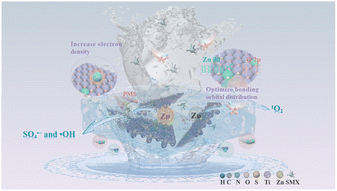
Constructing high-efficiency metal single-atom Fenton-like catalysts remains challenging due to unsatisfactory carrier development and insufficient understanding of metal–support interaction (MSI). In this work, an N-doped MXene-supported single-atom Zn (Zn–N-MXene) catalyst was designed and constructed, which produced a strong MSI effect, dramatically modulating the inert electronic structure of Zn and transforming it into a green and efficient peroxymonosulfate (PMS) activator. The Zn–N-MXene-3 with optimal Zn loading demonstrated an ultrahigh turnover frequency (TOF) of 3.16 min−1 for sulfamethoxazole (SMX) degradation, which was approximately 4.0 and 1.2 × 10³ times higher than that of single-atom Zn anchored on N-doped carbon nanotube (a common catalyst support) and homogeneous Zn2+ (no support), respectively, and greatly outperformed those of the state-of-the-art metal single-atom catalysts. Moreover, Zn–N-MXene-3 exhibited long-term effectiveness and stability in continuous-flow actual water decontamination. Theoretical calculations and experimental results collectively revealed the N-doped MXene played dual roles in improving the catalytic activity of the Zn center: (1) tt optimized the distribution of bonding states in Zn 3d orbitals and upshifted the d-band center of Zn, resulting in enhanced PMS adsorption and reduction into radicals (mainly ˙OH); (2) it enabled distinct electron enrichment on the Zn center, leading to the formation of more active Zn2+ species for participating in PMS activation.
 Please wait while we load your content...


