


Hierarchical RuO2/Co3O4 heterostructures enable efficient bromine-mediated electrochemical ethylene epoxidation via electronic and structural synergy

Abstract
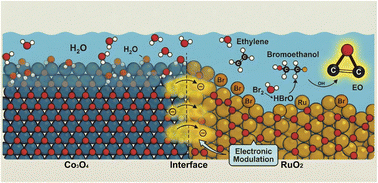
The conventional industrial process for ethylene epoxidation (EO) is challenged by high energy consumption and substantial carbon emissions. Bromine-mediated electrochemical EO synthesis offers a promising alternative, yet its economic viability is constrained by the reliance on high amounts of precious metal catalysts for the anodic bromine evolution reaction (BrER). Herein, we report a hierarchical and low-precious-metal RuO2/Co3O4 heterostructure, constructed by anchoring highly dispersed RuO2 nanoparticles onto Co3O4 nanorod arrays. The optimized RuO2/Co3O4 catalyst exhibits fast BrER reaction kinetics, high bromine-to-EO faradaic efficiency (>85%) over a wide current density range of 50–200 mA cm−2, and stable operation for over 20 h, outperforming most of the state-of-the-art BrER catalysts reported. Mechanistic studies combining XPS, in situ Raman spectroscopy, and DFT calculations reveal that interfacial charge transfer induces a unique electronic environment that weakens Br adsorption via a pre-oxidative interaction, while simultaneously stabilizing the cobalt oxide lattice against anodic reconstruction. This dual electronic–structural synergy enables high activity with reduced Ru loading, offering a viable strategy for developing durable and economical BrER anodes toward sustainable electrochemical ethylene epoxidation.
 Please wait while we load your content...


