


A coordination chemistry strategy of ammonia molecular pillaring for structurally reinforced Prussian blue cathodes in sodium-ion batteries
 *a
and
Jie
Sun
*abde
*a
and
Jie
Sun
*abde
Abstract
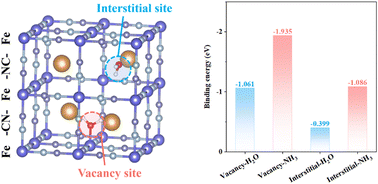
Prussian blue analogues (PBAs) are promising sodium-ion battery cathodes due to their high capacity, low cost, and spacious channels for sodium-ion diffusion, yet their large-scale application is hindered by intrinsic [Fe(CN)6]4− vacancies and crystal water. Although thermal dehydration can improve capacity, it simultaneously compromises structural integrity and increases material hygroscopicity. Herein, we report a molecular pillaring strategy that substitutes labile crystal water with stronger-coordinating ammonia (NH3). This approach achieves dual advantages. NH3 coordinates at vacancy sites to reinforce the lattice, meanwhile in situ generated NH4+ acts as structural pillars within interstitial cages. Furthermore, NH3 in the PB lattice binds protons during cycling, suppressing proton-induced side reactions and structural damage. Consequently, the NH3-pillared PB cathode delivers 113 mAh g−1 with 84.5% retention over 350 cycles and exhibits exceptional rate performance with over 90% retention at 10C. This molecular pillaring strategy establishes a generalizable pathway for engineering stable open-framework materials for energy storage.
- This article is part of the themed collection: Journal of Materials Chemistry A HOT Papers
 Please wait while we load your content...


