


Intercalated montmorillonite for fabricating a highly conductive and overall-stable solid composite electrolyte for advanced lithium metal batteries

Abstract
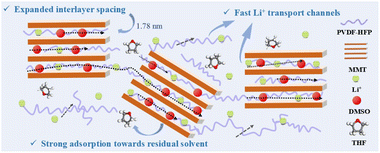
Solid-state lithium metal batteries are promising candidates for next-generation energy storage. However, their widespread applications are greatly hindered by the low ionic conductivity of the solid electrolyte and unstable interface towards Li metal. Herein, a novel pre-intercalation strategy using an organic molecule is proposed for modifying layered structure montmorillonite (MMT) as a functional filler in a solid composite electrolyte (SCE). Research results reveal that polar dimethyl sulfoxide (DMSO) successfully inserts into the MMT interlayers by hydrogen bonding interactions, effectively expanding the interlayer spacing without disrupting the inherent structure of the MMT. The pre-intercalated MMT filler not only creates continuous and ordered channels to conduct Li+ rapidly but also minimizes the detrimental effects of the residual solvent within the SCE by strong adsorption, thereby achieving overall enhancements of the SCE in ionic transport properties and electrochemical/thermal/mechanical stability. Consequently, excellent cycling capabilities with lessened polarization are illustrated in both the Li|Li symmetrical cell and the LiFePO4|Li full cell.
- This article is part of the themed collection: Journal of Materials Chemistry A HOT Papers
 Please wait while we load your content...


