


Dynamic hydrogen bond evolution in thermosensitive hydrogels for self-adaptive passive cooling
 *ab
*ab
Abstract
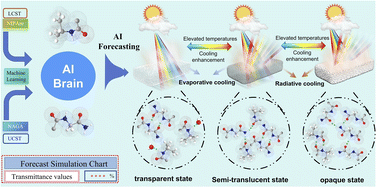
Facing the growing demand for green cooling, the application of thermosensitive hydrogels in adaptive thermal management is limited due to the kinetic-thermodynamic mismatch of water molecules during their phase transition. Herein, we propose a dynamic hydrogen bonding evolution hydrogel (hydrogen bonding energy in the P(NAGA-CO-NIPAm) hydrogel showing a temperature-dependent evolution) via artificial intelligence (AI) assisted component optimization to construct thermosentive hydrogels with a hierarchical synergistic dissipative pattern, which combine both phase-volume stability and optical transition properties, enabling adaptive passive cooling. The P(NAGA-CO-NIPAm)-4* thermosensitive hydrogel exhibits a triple synergistic mechanism (dynamic hydrogen bonding, hydrophobic aggregation, and light scattering) and excellent adaptive evaporative cooling capability (5 °C: 21.97 W m−2 → 25 °C: 53.99 W m−2 → 45 °C: 608.94 W m−2), which effectively solves the mismatch between water-molecule transport dynamics and the material thermodynamic response. At 45 °C, the cooling duration of the P(NAGA-CO-NIPAm)-4* hydrogel exceeded that of conventional PNIPAm hydrogels by over 10-fold. Compared to PNAGA and PNIPAm, P(NAGA-CO-NIPAm)-4* exhibits the best cooling capacity in extreme environments (60 °C and 800 W m−2), cooling to 41.33 °C (ΔT = 17.44 °C, 29.68%). The results provide a theoretical foundation and practical framework for next-generation adaptive cooling materials, with significant scientific and practical value in mitigating global cooling demands.
 Please wait while we load your content...


