


Rational embedding of DMAP into covalent triazine frameworks for efficient heterogeneous organocatalysis

Abstract
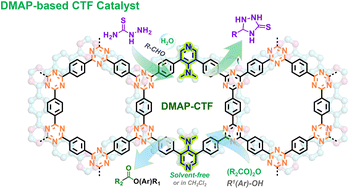
The development of a straightforward strategy to design and synthesize covalent triazine frameworks (CTFs) with high catalytic efficiency is of great importance. Here, we report the construction of a DMAP-embedded CTF (DMAP-CTF) via a mild aldehyde–amidine condensation, using 4-dimethylaminopyridine (DMAP) as the catalytic building block. The resulting DMAP-CTF exhibits limited crystallinity. Assisted by a NaCl template, the material achieves a high surface area of 675 m2 g−1 and a well-developed pore structure. Comprehensive characterization confirms the atomic-level incorporation of DMAP units within the triazine framework. DMAP-CTF acts as a highly effective heterogeneous catalyst for two types of green transformations: the solvent-free or in-solvent esterification of various alcohols and phenols (84–>99% yield) and the aqueous-phase synthesis of 1,2,4-triazolidine-3-thiones (86–95% yield). The catalyst demonstrates excellent stability and recyclability over 15 consecutive cycles. Furthermore, it was successfully implemented in a continuous-flow fixed-bed reactor for the scalable synthesis of phenolic esters, maintaining stable activity for at least 30 h. Through combined experimental and computational studies, the structure–activity relationship was elucidated, identifying the nucleophilic pyridinic nitrogen of the DMAP moiety as the key active site. This study highlights the potential of bottom–up constructed DMAP-integrated CTFs for advanced catalytic applications.
- This article is part of the themed collection: Journal of Materials Chemistry A HOT Papers
 Please wait while we load your content...


