


Environmentally friendly and energy-saving anode for nonferrous metal electrowinning operating through liquid–liquid phase separation
 *ab
*ab
Abstract
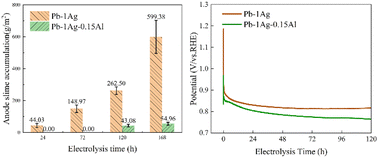
Lead–silver alloys have been extensively used as anode materials for nonferrous metal electrowinning. However, it is inevitable that harmful elements like Pb detaches from the anode and concentrates in the anode slime, electrolyte and cathode. The prevention and reduction of lead pollution is a challenging event. Here we successfully design and manufacture a Pb–Ag–Al alloy anode which exhibits excellent performances in synergistic inhibition of lead dissolution and reduction of harmful pollutants during the zinc electrowinning process. Compared to the broadly used Pb-1wt.%Ag alloy anode, the formation rate of anode slime reduces by about 90.8%, and the lead contents in the zinc product and electrolyte decrease by about 59.8% and 4.5% when the Pb-1wt.%Ag-0.15wt.%Al alloy is used as the anode after 168 h. Besides, the anodic potential of the Pb-1wt.%Ag-0.15wt.%Al alloy diminishes by about 3.6% and the generation amount of the cathode product increases by about 9%. The underlying mechanism of Al addition was clarified in-depth. It indicates that a thin and dense Al2O3 protective film forms during the zinc electrodeposition process when the Pb–Ag–Al alloy is used as the anode material, which is responsible for the reduction of hazardous pollutants. The low anodic potential is attributed to the formation of a spherical or nearly spherical Ag2Al phase. Our work not only provides a new strategy for the manufacture of an environmentally friendly and energy-saving Pb alloy anode, but also promotes the improvement of the product quality.
 Please wait while we load your content...


