


Molecularly modulated π-conjugated carbon nitride heterojunctions for efficient photocatalytic C–C bond cleavage in lignin models

Abstract
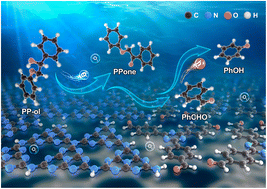
Photocatalytic cleavage of carbon–carbon bonds (PCC) with a carbon nitride-based catalyst represents a highly promising strategy for the sustainable conversion of lignin biomass into high-value aromatic chemicals. However, achieving well-matched energy alignment between the catalyst's electronic structure and the oxidation potential required for carbon–carbon bond cleavage remains a challenge. Herein, we report a molecularly modulated carbon nitride heterojunction catalyst (TFPT/g-C3N4), enabling efficient PCC in lignin models using atmospheric oxygen under simulated sunlight irradiation. The π-conjugated structure was preserved upon introducing 2,4,6-tris(4-formylphenyl)-1,3,5-triazine (TFPT) into g-C3N4. This modification not only improves the separation efficiency of photogenerated carriers (electron–hole), but also facilitates the generation of Cβ radicals during the hole oxidation process. In the oxidation model reaction of 2-phenoxy-1-phenylethanol (PP-ol), the TFPT/g-C3N4 catalyst showed high catalytic efficiency for PCC; the conversion of PP-ol was 94%, and the selectivity for Cα–Cβ bond cleavage was 91.5%. After four cycles, the activity decreased slightly, but still showed stability. Mechanistic studies via radical trapping, fluorescence quenching, EPR spectroscopy, and DFT calculations revealed that hole oxidation and superoxide radical generation synergistically induce the formation of Cβ radicals, which is a key step of PCC in lignin models. This work provides an effective strategy for the preparation of a series of g-C3N4 heterojunction materials with π-conjugation effects for the photocatalytic conversion of lignin.
 Please wait while we load your content...


