


 PLATFORM UPDATE:


Data-efficient training of machine learning interatomic potentials for MAX-phase synthesizability prediction

Abstract
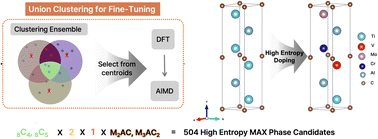
High-Entropy MAX (HE-MAX) phases hold the potential to extend the desirable characteristics of MXenes, including high electrical conductivity, enhanced catalytic activity, and low ion diffusion barriers. However, the synthesis of HE-MXenes requires that their precursor HE-MAX phases be stably synthesizable, and experimentally identifying such compositions remains highly challenging. To address this, we developed a machine learning interatomic potential (MLIP) to predict the thermodynamic stability of MAX phases in order to evaluate the synthesizability of HE-MXenes. MAX phases are generally represented by the formula Mn+1AXn, and in this study, a total of 504 structures were generated by combinations of four or five from eight transition metal candidates within the M2AX and M3AX2 structural types. During active learning, these 504 HE-MAX phases were then clustered, and the centroid of each cluster was chosen as a representative composition for fine-tuning the model. The fine-tuned CHGNet model achieved an mean absolute error of 0.031 eV per atom in the first iteration, which decreased to 0.027 eV per atom by the eighth iteration using only 401 structures outperforming the CHGNet benchmark of 0.029 eV per atom. Additional structural relaxations performed on vacancy-containing MAX phases further validated the model's robustness and generalization capability. In conclusion, the proposed MLIP framework provides an efficient and accurate pathway for screening thermodynamically stable HE-MAX compositions, offering a practical foundation for guiding future experimental synthesis of HE-MXenes.
 Please wait while we load your content...


