


 PLATFORM UPDATE:


Polarization field engineering through doping-induced anisotropic distortion for efficient piezo-photocatalysis
 *a
and
Haiyan
Li
*ab
*a
and
Haiyan
Li
*ab
Abstract
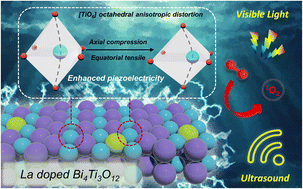
The development of piezo-photocatalysis provides a sustainable route to address energy and environmental challenges, yet current catalyst design remains limited by traditional photocatalytic concepts and insufficient understanding of structure–activity relationships in coupled systems. In this work, we propose doping-induced lattice and defect engineering in which La3+ without 6s2 lone pair electrons partially replaces Bi3+ in the [Bi2Ti3O10]2− perovskite-like layer of Bi4Ti3O12. The induced lattice strain causes anisotropic distortion of [TiO6] octahedra, enhancing the piezoelectric response. Although the photocatalytic activity is slightly reduced, the synergistic piezo-photocatalytic degradation efficiency of tetracycline hydrochloride (TCH) is markedly improved, with stable performance even under complex environmental conditions. This work highlights the importance of controllable piezoelectric modulation in piezo-photocatalyst design and emphasizes that an appropriate balance between piezoelectricity and photocatalytic performance should be considered as a key design principle. Furthermore, it provides a promising structural strategy for advancing piezo-photocatalysis toward sustainable energy conversion and environmental remediation.
 Please wait while we load your content...


