


Engineering a dual-site CuO/Cu2O/CeO2 heterostructure: synergistic Cu+/Cu2+ and CeO2 modulation for tandem ammonia electrosynthesis from nitrate

Abstract
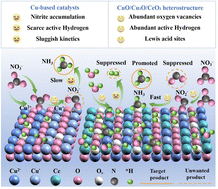
The electrochemical nitrate reduction reaction (eNO3RR) offers a sustainable strategy for ammonia (NH3) synthesis while simultaneously addressing nitrate pollution. However, its reaction kinetics and selectivity remain constrained, especially on Cu-based electrocatalysts, owing to the premature desorption of the nitrite intermediate (*NO2), which undermines both the NH3 production rate and faradaic efficiency (FE). In this work, a CuO/Cu2O/CeO2 heterostructure is fabricated on nickel foam via in situ growth and subsequent calcination. By precisely tuning the calcination temperature, the Cu+/Cu2+ ratio is effectively modulated. The incorporation of CeO2 induces abundant oxygen vacancies and Lewis acid sites, which cooperatively stabilize Cuδ+ (1 < δ < 2) species. This synergistic effect enhances the adsorption of nitrogen-containing intermediates and facilitates hydrogen spillover from CeO2 to CuO/Cu2O through water dissociation, thereby enabling a [2 + 6]-electron tandem pathway: NO3− is first reduced to NO2− (2-electron step) over CuO/Cu2O, followed by conversion of NO2− to NH3 (6-electron step) over CuO/Cu2O/CeO2. Consequently, the catalyst markedly suppresses the hydrogen evolution reaction and the accumulation of *NO2. Under optimized conditions (1 M PBS with 0.1 M KNO3, applied potential of −0.65 V vs. RHE) in a neutral electrolyte, the catalyst achieves a record faradaic efficiency of 99.85% and an NH3 yield of 43.37 mg h−1 cm−2, along with outstanding stability over 120 hours. Furthermore, a proof-of-concept Zn–NO3− battery incorporating this catalyst delivers a power density of 7.10 mW cm−2. This study underscores the critical role of copper pair sites and their synergy with CeO2 in advancing nitrate-to-ammonia electrocatalysis.
 Please wait while we load your content...


