


Interfacial C–S bonding stabilizes phase-tailored Ni heterosulfides on carbon nanofibers for bifunctional electrolytic water splitting
 *a
*a
Abstract
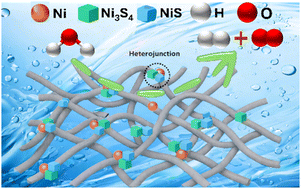
The development of efficient and cost-effective electrocatalysts is critical for advancing durable water-splitting systems. Special attention must be given to catalyst design, functionality, and interface regulation strategy to create synergistic effects that enhance electrocatalytic performance. We present a rational design of non-precious optimized heterojunction electrocatalysts comprising nickel (Ni0), Ni3S4 and NiS, supported on a 3D cross-linked carbon nanofiber (CNF) network. Detailed characterization supported by density functional theory calculations reveals lattice-matching heterojunctions between Ni3S4, NiS, and Ni, where strong C–S bonding stabilizes the heterojunction and ensures effective electronic coupling. These heterogeneous interfaces serve as highly electroactive regions, significantly enhancing charge transfer, structural stability, and reaction kinetics. The DFT simulations further confirm the favorable electronic structures and energetic pathways, providing insights into the enhanced catalytic behavior. The optimized Ni3S4/NiS/Ni@CNF composite demonstrates exceptional bifunctional performance, achieving a low hydrogen evolution reaction overpotential of 88 mV at 10 mA cm−2 with a Tafel slope of 34 mV dec−1 and an oxygen evolution reaction overpotential of 330 mV at 10 mA cm−2 with a Tafel slope of 45 mV dec−1, alongside excellent durability. In a two-electrode configuration, it achieved 10 mA cm−2 at 1.65 V with exceptional stability for 100 hours, showing excellent overall water splitting. The superior electrocatalytic performance is attributed to synergistic interactions at the Ni3S4, NiS, Ni, and CNF heterointerfaces, enhanced electronic conductivity, increased catalytic site exposure, and efficient interfacial charge transfer. This work offers a new strategy for the rational design of heterojunction-based materials with superior electrochemical performance in water-splitting applications.
- This article is part of the themed collection: Advanced Nanomaterials for Sustainable Green Hydrogen Production
 Please wait while we load your content...


