


Asymmetric coordination of metal–organic frameworks with enhanced metal–oxygen hybridization for Li–O2 batteries
 a
Fujun
Li
*a
a
Fujun
Li
*a
Abstract
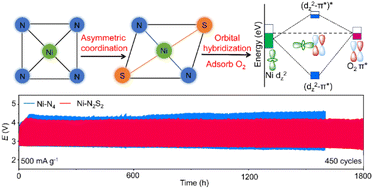
Aprotic Li–O2 batteries have drawn considerable attention owing to their high theoretical energy density, but their sluggish cathode reaction kinetics leads to large overvoltages and poor cycling stability. Herein, freestanding one-dimensional Ni–DABDT (2,5-diaminobenzene-1,4-dithiol) metal–organic frameworks with asymmetric coordination configuration (Ni–N2S2) are synthesized as catalytic cathodes for Li–O2 batteries. The asymmetric Ni–N2S2 coordination stabilizes the low-spin state of the Ni center, and it promotes O2 chemisorption and hybridization between the Ni 3dz2 orbital and the π* orbital of O2. This accelerates oxygen redox kinetics and promotes the formation of small-sized toroidal Li2O2 particles on Ni–N2S2 during discharge and hence facilitates their reversible decomposition. As a result, the Li–O2 batteries exhibit a low overvoltage gap of 0.61 V, superior rate performance and long-term stability over 450 cycles, while a 50 mAh pouch cell also demonstrates good cycle stability. This work highlights the importance of coordination environment regulation in electrocatalysts for Li–O2 batteries.
- This article is part of the themed collection: Journal of Materials Chemistry A HOT Papers
 Please wait while we load your content...


