


 PLATFORM UPDATE:

Multilayer (Cr/Au)n/PAA nanoporous membrane for ultrafast, selective CO2 detection at room temperature
 a
Mohamed
Shaban,
*b
Salhah D.
Al-Qahtani,
a
Rana
Saad
c
and
Khaled
Abdelkarem
d
a
Mohamed
Shaban,
*b
Salhah D.
Al-Qahtani,
a
Rana
Saad
c
and
Khaled
Abdelkarem
d
Abstract
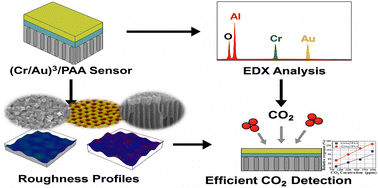
Achieving high-performance CO2 sensing at room temperature remains a significant challenge due to persistent trade-offs between sensitivity, selectivity, and energy efficiency. In this study, we present a robust and scalable gas sensing platform based on nanoporous anodic aluminum oxide (PAA) membranes functionalized with sequentially deposited nanolayers of Cr and Au. Three distinct multilayer sensor structures, (Cr/Au)n/PAA with n = 1, 2, and 3, were developed using a modified fabrication process that combined two-step anodization, pore widening, and RF sputtering. These configurations were thoroughly characterized through scanning electron microscopy (SEM), energy-dispersive X-ray spectroscopy (EDX), UV–vis spectroscopy, and electrical response analysis under CO2 exposure. Among them, the (Cr/Au)3/PAA sensor exhibited the most pronounced performance, achieving a high relative response of 160.69% at 4440 ppm CO2, with rapid response and recovery times ranging from 60.4–95.95 s and 24.42–99.04 s, respectively. These enhancements are attributed to the optimized multilayer architecture, which increases surface roughness, active site density, and charge transfer efficiency. The sensing mechanism is governed by reversible interactions between CO2 molecules and pre-adsorbed oxygen species, modulating the carrier concentration within the metallic layers. Long-term stability tests over 30 days confirmed excellent repeatability, while selectivity measurements revealed a strong preference for CO2 over interfering gases such as C2H2 and H2. This work demonstrates a promising route toward low-power, high-fidelity gas sensors and establishes a versatile framework for tailoring gas selectivity and sensitivity through nanoscale interface engineering.
 Please wait while we load your content...


