


Inhibiting defect formation and degradation at the buried interface of tin perovskite solar cells by modulating PEDOT:PSS with sodium alginate

Abstract
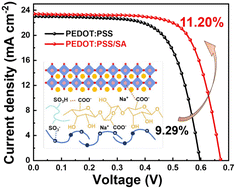
Tin (Sn)-based perovskite solar cells (TPSCs) have garnered significant attention due to their low toxicity and high theoretical efficiency. However, the high defect density and chemical degradation at the buried interface severely restrict device performance. Herein, natural polysaccharide sodium alginate (SA) is used to modify the buried interface between Sn perovskite and the poly(3,4-ethylenedioxythiophene):poly(styrenesulfonate) (PEDOT:PSS) hole transport layer. The polyionic SA exhibits strong interactions with PEDOT:PSS through electrostatic and chemical coordination effects, thereby effectively reducing the acidic PSS component. Besides, the abundant carboxyl (–COO−) and hydroxyl (–OH) groups of SA effectively regulate the formation of high-quality Sn perovskite films with larger grains and fewer defects. The bilateral regulation by SA significantly reduces defect density and suppresses the oxidative degradation process at the buried interface. Consequently, SA-modified FA0.75MA0.25SnI3 TPSCs achieve an efficiency of 11.20%, substantially exceeding the 9.29% of the control. The SA modification strategy also proves effective for Cs0.1FA0.6MA0.3Sn0.5Pb0.5I3 based PSCs, boosting their efficiency from 18.70% to 22.25%. Moreover, TPSCs based on SA-modified PEDOT:PSS exhibit markedly enhanced storage stability. This work addresses the buried interface in TPSCs by using green and low-cost natural materials as bilateral regulators.
 Please wait while we load your content...


