


A robust core–shell design to stabilize MnO2 and activate Prussian blue for high-performance zinc-ion batteries
 *a
*a
Abstract
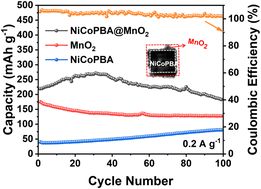
Aqueous zinc-ion batteries (AZIBs) are considered promising candidates for safe energy storage. However, their development is hindered by the inherent limitations of cathode materials: MnO2 suffers from low conductivity, slow ion diffusion, and manganese dissolution, while Prussian blue analogues (PBAs) exhibit low specific capacity and structural instability. To address these challenges, we rationally design and synthesize a core–shell NiCoPBA@MnO2 composite via a simple two-step method. This architecture integrates a stable NiCoPBA core with a highly active MnO2 shell, synergistically combining their advantages. The NiCoPBA core provides a robust framework to buffer volume changes and facilitate ion transport, while the MnO2 shell offers abundant active sites for redox reactions. Ex situ XPS analysis reveals a dual-redox mechanism involving Mn2+/Mn3+/Mn4+ in the shell and Co2+/Co3+ in the core, which significantly boosts the composite's specific capacity, while electrochemically inert Ni in the core strengthens the lattice framework, imparting excellent cycling stability. As a result, the NiCoPBA@MnO2 cathode exhibits outstanding electrochemical performance, delivering a high reversible specific capacity of 270.1 mAh g−1 at 0.2 A g−1 and maintaining 86.2 mAh g−1 after 800 cycles at 1 A g−1. It also demonstrates excellent rate capability and remarkable reversibility. This work presents an effective strategy for designing high-performance and durable cathodes for next-generation AZIBs.
- This article is part of the themed collection: Journal of Materials Chemistry A HOT Papers
 Please wait while we load your content...


