


 PLATFORM UPDATE:


Triisopropylsilylethynyl-substituted solid additives for morphology optimization affording high-efficiency organic solar cells
 b
and
Qian
Zhang
*a
b
and
Qian
Zhang
*a
Abstract
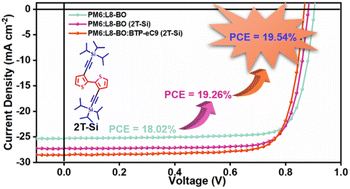
High-performance organic solar cells (OSCs) require precise control of the active layer morphology, as it critically governs exciton dissociation and charge transport. Solid additives provide an effective strategy to optimize molecular packing and fine-tune film morphology. Herein, two novel triisopropylsilylethynyl (TIPS)-based solid additives, 2T-Si and TT-Si, were designed and introduced into PM6:L8-BO OSCs to optimize active layer morphology. These additives strengthen intermolecular interactions, particularly with the acceptor material, leading to enhanced crystallinity, closer π–π stacking, and improved exciton dissociation and charge transport dynamics. As a result, the devices achieved high power conversion efficiencies of 19.26% with 2T-Si and 19.00% with TT-Si, significantly surpassing that of the control device (18.02%), alongside improved thermal stability. A ternary system incorporating BTP-eC9 with 2T-Si further achieved a champion efficiency of 19.54%. This study highlights the crucial function of molecularly tailored solid additives in simultaneously boosting efficiency and stability in high-performance organic photovoltaics.
- This article is part of the themed collection: Journal of Materials Chemistry A HOT Papers
 Please wait while we load your content...


