


Lithium dendrite holey strategy for enabling a high-rate and wide-temperature all-solid-state Ti3C2Tx fiber supercapacitor

Abstract
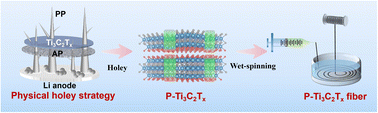
Ti3C2Tx nanosheets are considered one of the ideal precursor units for constructing fiber electrodes in fiber-shaped supercapacitors (FSCs) due to their high conductivity, abundant active sites, and excellent flexibility. Introducing porosity into Ti3C2Tx nanosheets for assembling fiber electrodes is a promising strategy to enhance axial ion transport along vertical fibers. However, current porous Ti3−αC2Tx−β nanosheets prepared using conventional chemical etching methods often suffer from a significant loss of Ti and surface functional groups, resulting in poor wettability of the material in the dispersion medium, difficulties in fiber spinning, and a substantial reduction in oxidation/reduction active sites. Herein, a lithium-dendrite piercing technology was proposed to prepare physical pore-engineered Ti3C2Tx (P-Ti3C2Tx) nanosheets without degradation of the Ti/C ratio. Meanwhile, P-Ti3C2Tx was spun into fibers based on their excellent ink properties and liquid crystal dispersibility. The obtained P-Ti3C2Tx fiber electrode exhibited an outstanding volumetric capacitance of 1413 F cm−3, along with exceptional rate capability (86% capacity retention at 20 A cm−3). Besides, a non-toxic and wide-temperature polyvinyl alcohol-glycerol hydrogel electrolyte was developed for P-Ti3C2Tx-based FSCs. These FSCs achieved a remarkable volumetric energy density of 320.5 mWh cm−3 at 26.5 mW cm−3, maintained 80% capacitance after 20 000 cycles, and operated stably across a wide temperature range (−40 to 60 °C). This work provides a unique methodology for high-performance and wide-temperature FSCs in next-generation wearable energy storage systems.
 Please wait while we load your content...


