


 PLATFORM UPDATE:


Realizing high energy storage performance in (Na0.47Bi0.47)Ba0.06TiO3-based ceramics with a slush-like polar state

Abstract
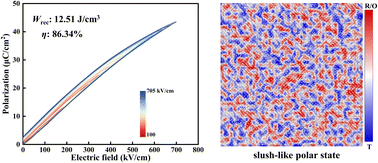
Dielectric capacitors with superior energy storage properties are critical components in modern power electronics, owing to their exceptional power density and ultrafast discharge characteristics. Nevertheless, the practical implementation of these devices has been largely constrained by insufficient energy storage density (Wrec) and relatively low efficiency (η). In this work, we substantially improve these properties in (Na0.47Bi0.47)Ba0.06TiO3 (BNBT)-based ceramics by engineering a slush-like polar state, achieving a high Wrec of 12.51 J cm−3 and a large η of 86.34%. The obtained ceramics also demonstrate excellent stability across a wide frequency (1–160 Hz) and temperature (25–140 °C) range. Atomic-scale local structure analysis revealed that the nanodomains evolve into ultrafine polar nanoregions (approximately 1–2 nm), which exhibit multiphase coexistence. Piezoresponse force microscopy analysis confirms that this unique feature contributes to reduced hysteresis while retaining high polarization. This research presents a viable and effective approach to designing high-performance dielectric capacitors for advanced energy storage applications.
 Please wait while we load your content...


