


Macroscopical graphyne-based membranes and thin films: design, preparation and application
 *a
Chunxi
Li
*a
and
*a
Chunxi
Li
*a
and
Abstract
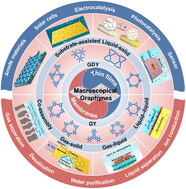
Graphynes feature a two-dimensional (2D) planar carbon network with sp/sp2 hybridization, representing a novel class of carbon allotropes. Given their peculiar characteristics—including abundant acetylenic bonds, extensive π-conjugated systems, uniform natural pores, significant charge distribution heterogeneity, and outstanding chemical stability—graphynes have shown huge potential across diverse industries. Macroscopical graphyne-based membranes and thin films (GMTFs) with controllable structures are important forms of graphyne materials that exert their properties in various fields. This critical review summarizes the reticular design and issues associated with graphynes for membranes and thin films. It also discusses recent progress in fabricating supported and self-standing macroscopical membranes and thin films using interfacial synthetic strategies, along with co-assembly synthesis. Moreover, applications of GMTFs are also introduced by analyzing the structure–function relationship. Finally, perspectives on fundamental challenges and outlooks regarding macroscopical GMTFs are put forward to facilitate future research.
- This article is part of the themed collection: Journal of Materials Chemistry A Recent Review Articles
 Please wait while we load your content...


