


Defect-rich ZnFeCo spinel oxide for enhancing the performance of various electrocatalytic reactions and producing high value-added chemicals

Abstract
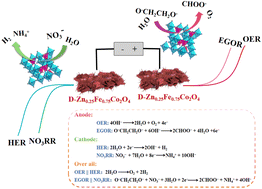
Reasonable design and efficient synthesis of multifunctional electrocatalysts are crucial for promoting energy conversion, green manufacturing, and pollutant upcycling. In this study, the spinel oxide of Zn0.25Fe0.75Co2O4 with a mixed morphology of nanosheets and nanoneedles was prepared by combining hydrothermal and high-temperature annealing methods. Then, Zn0.25Fe0.75Co2O4 was transformed into D-Zn0.25Fe0.75Co2O4 enriched with both metal and oxygen defects based on an electrochemical etching strategy. The electrochemical etching method facilitated the cleavage of metal–oxygen bonds and the exposure of more active sites in the oxide, optimized the electronic structure and formed a defect-rich structure, thereby enhancing the participation of lattice oxygen in electrocatalytic reactions. D-Zn0.25Fe0.75Co2O4 exhibited excellent electrocatalytic performance in 1.0 M KOH, 1.0 M KOH + 0.5 M EG, and 1.0 M KOH + 0.1 M NaNO3 electrolytes. For anodic oxidation reactions, the overpotential of the oxygen evolution reaction (OER) was 262 mV at 100 mA cm−2 and the potential of ethylene glycol oxidation reaction (EGOR) was 1.372 V at 100 mA cm−2, with a formate yield of 0.86 mmol cm−2 h−1 and a faradaic efficiency (FE) of 94.81%. For cathodic reduction reactions, the overpotential of the hydrogen evolution reaction (HER) was 254 mV at 100 mA cm−2 and the potential of nitrate reduction reaction (NO3RR) was −0.08 V at 100 mA cm−2, with an ammonia yield of 19.67 mmol cm−2 h−1 and an FE of 95.3%. A two-electrode system (NO3RR‖EGOR) assembled with D-Zn0.25Fe0.75Co2O4 as the bifunctional electrode realized the synergistic catalytic reactions of synthesizing formate by the anodic EGOR and reducing nitrate to ammonia by the cathodic NO3RR, and it had a lower cell voltage than that of the conventional water electrolysis system (HER‖OER). This study enhances the electrocatalytic small-molecule conversion of spinel oxides through defect engineering to produce high value-added chemicals, providing novel ideas for related fields.
 Please wait while we load your content...


