


Defect-rich Ni-TDC by Fe(iii) ions substitution at Ni2 sites for high-performance asymmetric supercapacitors
 *ab
and
Yanfang
Gao
a
*ab
and
Yanfang
Gao
a
Abstract
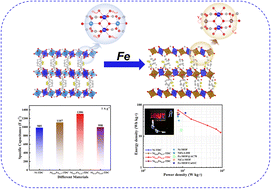
The Ni-TDC material exhibits high specific capacity and rate capability as a supercapacitor cathode; however, its practical application is limited by poor intrinsic conductivity. To overcome this issue, we introduced Fe(III) ions to selectively substitute at the Ni2 sites in the Ni-TDC nanoflowers, enabling the generation of lattice defects and oxygen vacancies. In the resulting NixFe1−x-TDC series, these oxygen vacancies significantly enhance electrical conductivity by introducing additional charge carriers and creating localized charge imbalances. Furthermore, these defects facilitate electron migration by offering efficient transport pathways, thereby improving overall charge transfer kinetics. The Ni0.67Fe0.33-TDC electrode demonstrates exceptional electrochemical performance, achieving a specific capacitance of 1306 F g−1 at 1 A g−1, which represents a substantial increase from the 985 F g−1 of pristine Ni-TDC. In a practical asymmetric supercapacitor configuration with Ni0.67Fe0.33-TDC as the cathode and activated carbon as the anode, the device delivers a high energy density of 67 Wh kg−1 at a power density of 819 W kg−1, along with remarkable cycling stability (74% capacitance retention after 10 000 cycles). Density functional theory (DFT) calculations confirm that Fe(III) ions substitution at the Ni2 sites was energetically favourable and that oxygen vacancies play a critical role in promoting electron transport, thereby enhancing intrinsic conductivity. In contrast to conventional Fe–Ni-MOF electrodes based on random doping or post-synthetic defect regulation, this work presents a novel site-selective doping strategy combined with defect engineering. This innovative approach leads to a significant improvement in the capacitive performance of Fe–Ni-MOF-based supercapacitors.
 Please wait while we load your content...


