


Integration of chemical component control and a pillared parallel structure for efficient water electrolysis
 *ab
*ab
Abstract
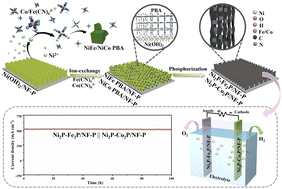
The development of green hydrogen energy offers a promising solution to mitigate fossil fuel depletion and environmental pollution. Water electrolysis is considered a key technology for efficiently converting intermittent renewable energy into hydrogen fuel. Herein, a hierarchical electrocatalyst was constructed by integrating Prussian blue analog nanocubes into the interlayer spacing of parallel nanosheet arrays, followed by phosphorization to obtain metal phosphide derivatives with simultaneously enhanced intrinsic activity and structural stability. The long-range ordered nanosheet architecture and uniform interlayer pillared nanocubes can effectively suppress random structural deformation and stacking, thereby increasing active site exposure and promoting rapid gas release. Meanwhile, the incorporation of heteroatoms and metal phosphides imparts excellent bifunctional electrocatalytic performance. Specifically, Ni2P-Fe2P/NF-P achieves a low overpotential of 290 mV at 500 mA cm−2 for the oxygen evolution reaction, while Ni2P-Co2P/NF-P exhibits an overpotential of only 253 mV at 500 mA cm−2 for the hydrogen evolution reaction, as well as high stability for over 100 h. Meanwhile, the Ni2P-Fe2P/NF-P‖Ni2P-Co2P/NF-P electrolyzer maintains high activity and stability for overall water splitting. These results highlight the synergistic effect between active composition incorporation and physical structural engineering to simultaneously boost mass transfer and reaction, offering a promising electrocatalyst design strategy for overall water splitting.
 Please wait while we load your content...


