


Demulsification-enabled entanglement anchoring prepared superlubrication hydrogel for antifouling of vessel surfaces
 a
and
Yuanpeng
Wu
*ab
a
and
Yuanpeng
Wu
*ab
Abstract
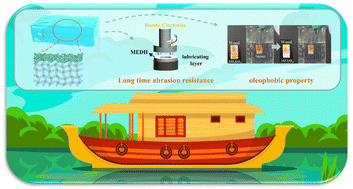
Hydrogels, known for their high water content and biocompatibility, have garnered attention for applications necessitating lubrication and antifouling properties. However, their practical implementation is often hindered by inadequate mechanical robustness, intricate fabrication processes, and diminished lubricity under dynamic stress conditions. In this study, we introduce a bilayer-structured hydrogel (MEDH) synthesized via a novel and simple one-pot demulsification strategy employing a water-in-oil emulsion precursor. The hydrophilic polymer chains of acrylamide and acrylic acid are interlaced within a methyl acrylate-based framework, resulting in a stable, hydration–rich interface, such a hydration layer forms when water molecules surround ions or polar groups, thereby reducing the exposure of polar groups on the hydrogel surface. This process not only decreases the likelihood of interfacial chemical interactions but also minimizes the adhesion of oils and other contaminants. The resultant MEDH exhibits an ultralow friction coefficient (as low as 0.006) and maintains consistent lubrication (∼0.02) under a 30 N load after 50 000 sliding cycles. Furthermore, MEDH demonstrates exceptional antifouling performance, achieving a superoleophobic state with an underwater oil contact angle of 153 ± 3.19°. This synergistic integration of lubrication and antifouling capabilities offers a straightforward yet robust approach for engineering multifunctional hydrogels, potentially facilitating their application in high-load, contaminant-prone environments.
 Please wait while we load your content...


