


 PLATFORM UPDATE:


Synthesis of nonstoichiometric pseudobrookite (Fe2−xTi1+xO5) from ilmenite for use in flexible microsupercapacitors

Abstract
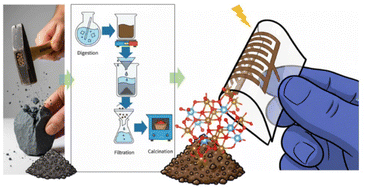
Flexible microsupercapacitors (MSCs) require electrode materials that combine high rate capability, useful energy density, and scalable manufacturing. We report a hydrometallurgical route that converts natural ilmenite into nonstoichiometric pseudobrookite (Fe2−xTi1+xO5) via coprecipitation and calcination, which yields pseudobrookite nanopowder with approximately ∼14 nm crystallite size with mixed Fe2+/Fe3+ and Ti3+/Ti4+ states. Spectroscopy and DFT calculation results confirm a defect rich electronic structure with a narrowed bandgap (∼1.955 eV) for the synthesized powder. Flexible microsupercapacitors fabricated on PET with a PVA/H2SO4 gel exhibit hybrid charge storage with quasi rectangular CVs and near triangular GCD, and retain ∼91.7% capacitance after 5000 cycles for the pseudobrookite/carbon black composite sample. An asymmetric design pairing a pseudobrookite electrode with graphene extends the stable operating window to 2.0 V and delivers an areal energy density of 1.13 µWh cm−2 at 2.71 µW cm−2 power density with robust performance under bending. To our knowledge, this is the first application of pseudobrookite in MSCs and the first ore to device demonstration for flexible energy storage, establishing a practical pathway to low cost, scalable power sources for wearable and portable electronics.
 Please wait while we load your content...


