


Oriented tubular metal–organic framework superstructures via conjugate acid–base pair-mediated growth regulation

Abstract
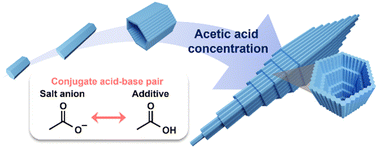
Oriented metal–organic framework (MOF) superstructures, distinguished by unique collective properties stemming from their ordered particle arrangements, have garnered significant interest. However, their controlled synthesis remains challenging due to the complexity of existing methods and limited insights into bottom-up growth mechanisms. Here, we introduce a simple, one-pot synthesis of oriented [Zn2(BDC)2DABCO]n (BDC = 1,4-benzenedicarboxylic acid, DABCO = 1,4-diazabicyclo[2.2.2]octane, ZnBD) superstructures under ambient conditions. We develop a conjugate acid–base pair strategy, utilizing salt-derived anions paired with corresponding acid additives in the reaction medium. Specifically, acetate anions from zinc acetate form a conjugate acid–base pair with added acetic acid. This pair selectively governs anisotropic growth and dissolution–recrystallization processes, yielding oriented tubular superstructures composed of crystallographically aligned nanorod ZnBDs. This distinctive morphological evolution occurs with the acetate anion–acetic acid pair and shows a clear dependence on acetic acid concentration. The resulting tubular superstructures, with their hierarchical architecture, exhibit enhanced CO2 adsorption capacity compared to their nanocrystal counterparts. This work offers an energy-efficient approach to synthesizing oriented MOF superstructures under ambient conditions, using stoichiometric precursors and non-toxic additives.
 Please wait while we load your content...


