


 PLATFORM UPDATE:


Window layer engineering of kesterite CZTSSe thin-film solar cells
 a
Jin Hyeok
Kim
*a
a
Jin Hyeok
Kim
*a
Abstract
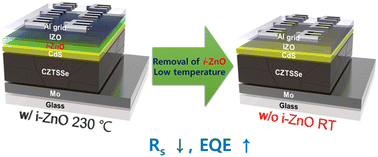
Normally, the intrinsic zinc oxide (i-ZnO) layer plays a crucial role in Cu2ZnSn(S,Se)4 (CZTSSe)-based thin-film solar cells (TFSCs) by improving charge collection and stabilizing the interface between the buffer and the transparent conducting oxide (TCO) layers. However, the inclusion of the i-ZnO layer can raise additional series resistance, adversely affecting carrier transport and relatively poor device performance. Eliminating this layer may simplify the fabrication process and enhance the performance; however, its absence can compromise the performance due to elemental interdiffusion and defect formation at high temperatures. This study systematically investigates the influence of the presence or absence of the i-ZnO intermediate layer and TCO deposition temperature on the performance of the CZTSSe TFSCs. By eliminating the i-ZnO layer and lowering the TCO deposition temperature, we aimed to minimize damages to the underlying layer, suppress formation of defect at interface, reduce series resistance, and thereby enhance the device performance. Interestingly, i-ZnO free CZTSSe TFSC with room temperature deposited TCO showed significantly improved device parameters and performances compared to those with i-ZnO and/or high temperature deposited TCO. Our results suggested that eliminating the i-ZnO layer combined with a room-temperature-deposited TCO strategy can simplify the device fabrication process and offer a cost-effective pathway for the early industrialization stage.
 Please wait while we load your content...


