


Defect formation and microstructure tuning via proton irradiation to control electrochemical and phase reversibility in layered battery materials

Abstract
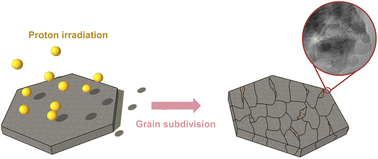
The reversibility of phase transformation influences the functionality of electrode materials in batteries. In many battery materials, nanosized grains favor phase reversibility but at the cost of cyclability due to aggravated side reactions with the electrolyte. In this study, we present a novel approach to enhance the phase transformation reversibility of layered oxide cathodes, exemplified by Na2/3Fe1/2Mn1/2O2 through proton irradiation. In addition to forming defects, proton irradiation at sufficiently high doses can subdivide single grains into multiple nanodomains without physically rupturing them. Hence, the single grains of the material assume a pseudo-secondary particle nature without reducing the overall grain size. Preserving the grain size is advantageous, as it reduces side reactions, which is not possible with conventional grain size reduction methods. While chemical transformations and defect formation induced through proton irradiation can influence the stability of battery materials, it is expected that structural reorganization due to cycling-induced phase transformation will be contained within these nanodomains. Such confinement of phase transformation is potentially responsible for enhancing the reversibility of layered oxide materials in our study. Thus, our study suggests that grain subdivision could become an effective microstructure tuning strategy for managing electrochemical cycling-induced phase changes in battery electrodes.
- This article is part of the themed collection: Journal of Materials Chemistry A Emerging Investigators 2026
 Please wait while we load your content...


