


Decoupling electrical conductivity and Seebeck coefficient via isoelectronic alloying in the 9-4-9-type Ca9−yEuyZn4.7Sb9 (0 ≤ y ≤ 5.0) Zintl phase

Abstract
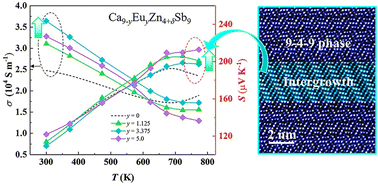
Thermoelectric materials face a fundamental challenge due to the strong coupling between electrical conductivity and Seebeck coefficient. Here, we demonstrate that Eu alloying in the 9-4-9-type Zintl phase Ca9−yEuyZn4.7Sb9 (0 ≤ y ≤ 5.0) gives rise to an “intergrowth” structure, which effectively decouples these properties. Advanced characterization techniques, including electron energy loss spectroscopy (EELS) and X-ray absorption spectroscopy (XAS), reveal that the valence state of Eu in this “intergrowth” structure is a mixture of +2 and +3. The “intergrowth” structure with Eu3+ reduces carrier concentration, thereby enhancing the Seebeck coefficient. Concurrently, Cs-corrected transmission electron microscopy (TEM) quantitatively demonstrates that the intensity of interstitial Zn atoms gradually increases with Eu alloying, improving carrier mobility and boosting electrical conductivity. Consequently, a simultaneous enhancement of both the Seebeck coefficient (from 113 µV K−1 to 121 µV K−1) and electrical conductivity (from 2.5 × 10⁴ S m−1 to 3.26 × 10⁴ S m−1) is achieved in the 9-4-9-type Ca9−yEuyZn4.7Sb9 Zintl phase and the underlying mechanism behind the effective decoupling is uncovered. Our findings provide a new pathway for optimizing thermoelectric performance, offering valuable insights for the design of high-performance thermoelectric materials.
 Please wait while we load your content...


