


 PLATFORM UPDATE:

Computational study of multicharged cyclodextrin derivatives with deep cavities for high-affinity host–guest recognition
 *a
*a
Abstract
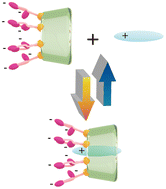
Cyclodextrin (CD) derivatives bearing multicharged side chains exhibit enhanced host–guest binding, with higher selectivity and affinity compared with natural CDs, due to their deep cavities, polar binding sites and electrostatic interactions. To further understand the relationship between their structures and molecular recognition, molecular dynamics simulations were performed on a series of multicharged CD hosts with per-6-substituted side chains and their oppositely charged guests. In the case of rocuronium bromide (ROC) as the guest, umbrella sampling identified glutamic acid-substituted γ-CD as the host, exhibiting the strongest host–guest binding, with a free energy of −103.1 kJ mol−1, followed in descending order by aspartic acid-substituted γ-CD, glycine-substituted γ-CD, succinic acid-substituted γ-CD, sugammadex, and adamgammadex. Meanwhile, molecular mechanics Poisson–Boltzmann surface area (MM-PBSA) analysis showed similar rankings, suggesting that electrostatic interactions play a dominant role in binding, while hydrophobic interactions, van der Waals forces, hydrogen bonding, and host–guest geometric complementarity act synergistically to stabilize the complexes. In addition, edrophonium@succinic acid-substituted β-CD and simvastatin@ammonium-substituted β-CD complexes were also evaluated, exhibiting binding free energies of −98.42 and −59.77 kJ mol−1, respectively. These findings provide mechanistic insights into CD derivative recognition and offer theoretical guidance for the rational design and experimental screening of high-affinity hosts.
 Please wait while we load your content...


