


 PLATFORM UPDATE:


The remarkable electrorheological behavior of amino-modified metal–organic frameworks with enhanced interfacial polarization
 *a
and
Chuncheng
Hao
*a
*a
and
Chuncheng
Hao
*a
Abstract
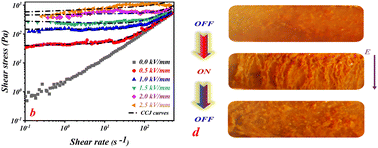
Herein, amino-modified metal–organic frameworks (MIL-125) were prepared by mixing two different ligands before and after the modification of polar groups (amino) under solvothermal reaction conditions. Through the design of the substitution ratio of the polar group (NH2), amino-modification not only enhances the polarization ability of MIL-125 but also induces rich porosity and irregular shape due to the asymmetry of the structure. The obtained amino-modified MIL-125 was then characterized in terms of its morphology, composition and structure, using X-ray diffraction (XRD), scanning electron microscopy (SEM), transmission electron microscopy (TEM), X-ray photoelectron spectroscopy (TEM), Fourier transform infrared spectroscopy (FT-IR), Brunauer–Emmett–Teller (BET) and dielectric analysis. The amino-modified MIL-125 retained the large specific surface area and low bulk density of the metal–organic frameworks, and achieved charge redistribution and obtained additional polarization ability through the introduction of polar groups. Ultimately, the amino-modified MIL-125 exhibits a higher level of polarization, which results in a pronounced electrorheological (ER) behavior of the ER fluids when used as the dispersed phase.
 Please wait while we load your content...


